Why skin type identification matters
Your skin type determines which ingredients your skin needs, which formulations to look for, and which to avoid. An oily skin type using heavy ceramide creams will see more breakouts. A dry skin type using mattifying gel moisturisers will see more tightness, flaking, and sensitisation. The right routine for your skin type isn't just more pleasant - it's meaningfully more effective.
The problem is that most people assess their skin immediately after washing, when it's been stripped of sebum and feels artificially tight or dry regardless of skin type. That's not an accurate reading.
The four main skin types
Normal skin
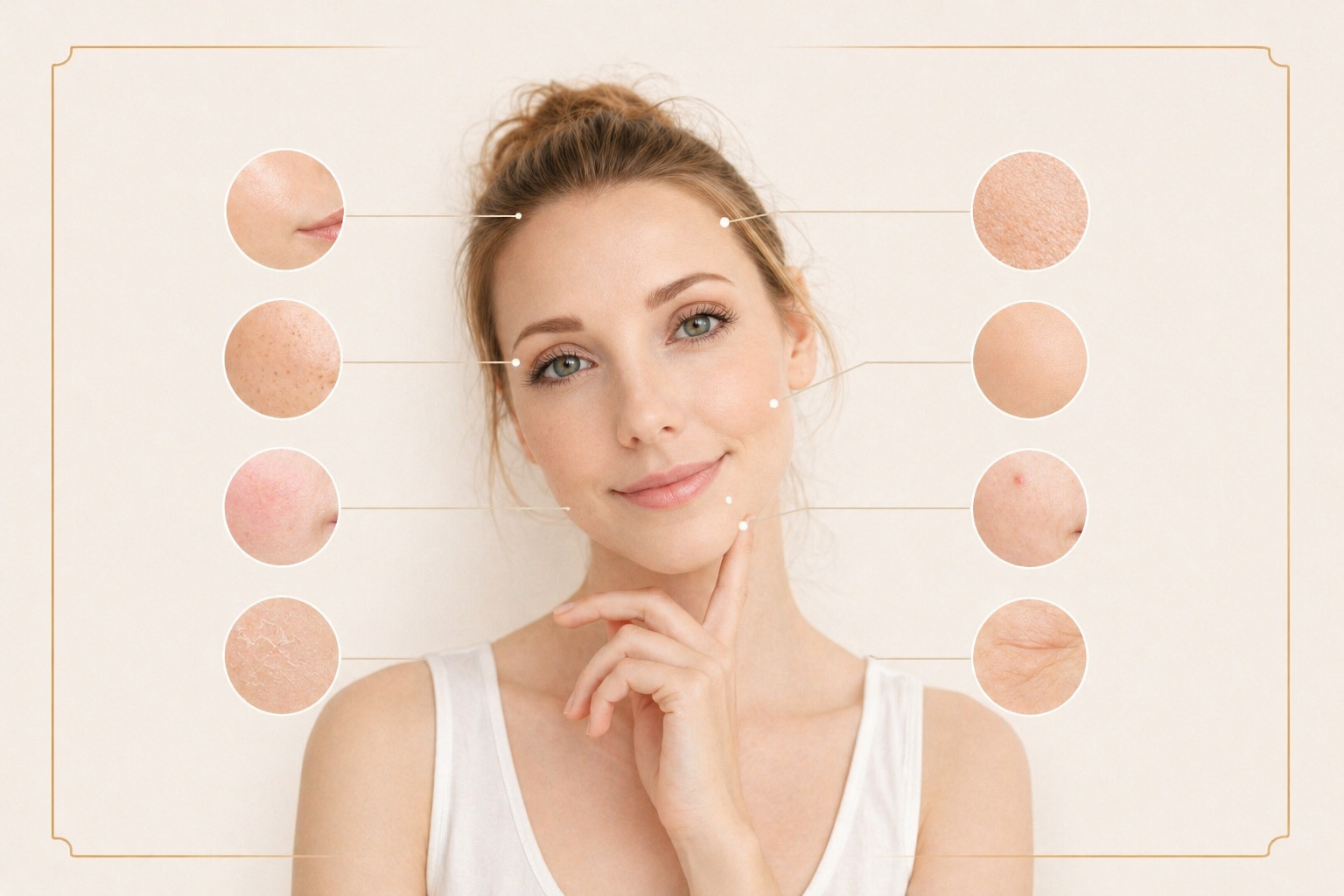
Balanced oil production, small pores, even texture, and minimal sensitivity. Skin feels comfortable most of the day - not tight, not shiny. Fine lines appear gradually rather than early. Normal skin can tolerate a wide range of products and requires maintenance rather than correction. It's the least common type, despite being what most people assume they have.
Dry skin
Produces less sebum than average. Skin often feels tight after cleansing, looks dull or rough, and may flake around the nose, cheeks, and forehead. Fine lines appear earlier and more prominently. Dry skin is more prone to sensitivity and barrier damage because its natural lipid production can't keep up with environmental demands.
Oily skin
Excess sebum production across the entire face - forehead, nose, cheeks, and chin all feel slick by midday. Pores appear enlarged (especially on the nose and forehead) and skin looks shiny in photos. More prone to blackheads and breakouts because excess oil mixes with dead skin cells and clogs pores. Despite the shine, oily skin can still be dehydrated - oil and water are different things.
Combination skin
The most common type. An oily T-zone (forehead, nose, chin) with normal or dry cheeks. The cheeks may feel tight or look matte while the nose looks shiny - often at the same time. Combination skin is the hardest to formulate for because what helps the T-zone can over-dry the cheeks, and vice versa.

Sensitive skin is not a separate skin type - it's a skin condition that can affect any type. You can have oily-sensitive, dry-sensitive, or combination-sensitive skin. Sensitivity describes reactivity; skin type describes oil production.
The bare-face test (most reliable method)
This is the most accurate way to identify your skin type at home. It takes about 90 minutes and requires no products or tools.
- Wash your face with a gentle, fragrance-free cleanser and pat dry
- Do not apply anything - no moisturiser, no toner, no serum
- Wait 60-90 minutes, doing normal activities
- After the waiting period, observe and feel your skin across different zones
What to look for:
- Shine or slickness across the whole face → oily
- Shine only on T-zone, normal cheeks → combination
- Tightness, flaking, or roughness → dry
- No shine, no tightness, comfortable → normal
The blotting paper test
If you have blotting papers or a clean tissue, press it gently against different areas of your face 60 minutes after washing (with no products). Hold each sheet up to the light:
- Oil visible from all zones → oily skin
- Oil only from T-zone → combination skin
- Little to no oil from any area → dry or normal
This method is faster but slightly less reliable than the bare-face observation - blotting papers vary in absorbency, and environmental humidity affects results.
Signs you've misidentified your skin type
Several signs suggest your current skin type assessment may be wrong:
- Your moisturiser always feels too heavy or too light - you may be using formulations designed for a different skin type
- Your skin looks worse after your routine - products incompatible with your skin type create new problems rather than solving existing ones
- Your skin feels tight and oily at the same time - this is often dehydrated oily skin, mistaken for combination or normal
- Breakouts only in certain areas - may indicate combination rather than oily skin
How skin type changes over time
Skin type is not fixed for life. The most common shifts:
- Teens to 20s - high androgen levels drive oily skin in adolescence. Many people find their skin becomes combination or normal by their mid-20s.
- Pregnancy and hormonal changes - contraception, pregnancy, and menopause all alter sebum production, sometimes dramatically.
- 30s to 40s - sebum production naturally declines with age. Oily skin often becomes combination; combination often becomes normal or dry.
- Seasonal changes - humidity and central heating affect hydration levels and apparent oil production. Summer often pushes skin oilier; winter drier.
It's worth reassessing your skin type every year or two, and whenever you notice your products are no longer working as expected.
Where to find a cleanser for your skin type
The single biggest product change after identifying your skin type is usually the cleanser. A wash matched to your skin will make every other step in the routine work better. The three options below cover the four main types, all from the dermatologist-recommended budget tier.
For oily and combination skin
For normal and dry skin
For sensitive skin (any type)
Some links above are affiliate links. As an Amazon Associate, Skinalyze AI earns from qualifying purchases at no extra cost to you. We only recommend products whose ingredient profile aligns with the science discussed above. Why we recommend these →
Frequently asked questions
Can I have more than one skin type?
Yes - combination skin is by definition two different skin types across different zones of the face. Some people also experience different skin types in different seasons, or have their type shift after major hormonal changes.
Is dehydrated skin the same as dry skin?
No. Dry skin is a skin type - a lack of oil production. Dehydrated skin is a temporary condition - a lack of water, which any skin type can experience. Oily skin can be dehydrated; dry skin can be well-hydrated. Dehydration is caused by environmental factors, lifestyle, and product choices, and is reversible.
My skin is different in summer and winter - does my skin type change?
Your underlying skin type stays relatively consistent, but its behaviour shifts with environment. In humid summers, oily skin produces more sebum and combination skin may behave more like oily. In dry winters with central heating, combination skin may behave more like dry. These are adaptations, not type changes - though they do affect which formulations work best for you seasonally.
Does skin type affect how I age?
Yes. Oily skin tends to develop fine lines later because natural sebum provides a degree of occlusion. Dry skin loses moisture more easily and shows fine lines earlier, particularly around the eyes and mouth. Combination skin ages differently across zones. Regardless of skin type, UV protection is the single most important factor in how skin ages.
How do I know if my skin type has changed?
The clearest signal is that products that worked well before no longer suit your skin - moisturisers feel too heavy or too light, your skin is suddenly breaking out where it didn't before, or previously comfortable products are causing tightness. Do the bare-face test again and reassess from there.