
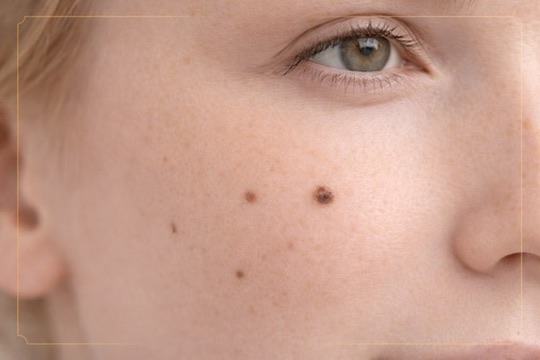
What is the ABCDE rule?
Developed to help people systematically evaluate skin spots, the ABCDE rule breaks down the key visual characteristics that dermatologists look for when assessing a mole. It's a descriptive tool, not a diagnostic one - and it's most useful when used consistently over time to detect change.
A - Asymmetry
Imagine drawing a line through the middle of the spot. In a symmetrical mole, both halves should look roughly the same. If one half looks noticeably different - in shape, colour, or size - that asymmetry is worth noting.
B - Border
Look at the edges of the spot. Are they smooth and well-defined? Or are they irregular, ragged, notched, or blurred? A clear, even border is generally reassuring. Borders that are hard to define deserve attention.
C - Colour
A single, uniform shade of brown is typical for common moles. Multiple colours within one spot - tan, dark brown, black, red, white, or blue - are worth documenting. Note any changes over time.
D - Diameter
The traditional guideline uses 6mm as a reference point. However, more useful than size alone is whether the spot is growing.
E - Evolution
This is arguably the most important letter. A mole that is changing - in size, shape, colour, or texture - is the key signal to act on. Most stable moles that have looked the same for years are of low concern.

Take a photo of each spot you're monitoring every 4-6 weeks, under the same lighting conditions and distance. Consistent documentation is far more useful than a single assessment.
What to do with your findings
If you notice any of the following, book an appointment with a dermatologist:
- A spot that is changing in any of the ABCDE characteristics
- A new spot that looks different from your other moles
- Any spot that bleeds, itches, or crusts without injury
Building a monitoring habit
- Do a full skin check once a month
- Photograph any spots you're watching
- Keep a visual record so you can compare over time
- Note any new spots that appear